

In recent months, the conversation around alternative investments in defined contribution plans has accelerated dramatically. With new federal actions and regulatory shifts, private equity and private credit are back in the headlines for potential inclusion in 401(k) plans. While innovation in retirement investing can expand diversification and access to new return streams, plan sponsors must tread carefully. Fiduciary responsibility under ERISA remains the North Star, and rushing to adopt alternatives without clear guidance could expose plans and committees to heightened litigation and reputational risk.
A Shifting Regulatory Landscape
- March 19-20, 2025: A Johns Hopkins Carey Business School study reviewed performance data across major private market strategies. The authors raised concerns about extended fund durations, limited transparency, and high fees, arguing that these features make private equity and private credit challenging fits for 401(k) plans.
- July 18, 2025: The Defined Contribution Alternatives Association (DCALTA) released a white paper recommending that plan sponsors consider allocations of 10 to 20 percent to private credit within target-date funds or managed accounts.
- August 6, 2025: The Committee on Capital Markets Regulation issued a report urging policymakers to broaden access to private markets. The report noted that private capital raising now outpaces IPO activity and recommended that the DOL modernize its framework for retirement plan investors.
- August 7, 2025: President Donald Trump signed an executive order directing the DOL, Treasury, and SEC to reevaluate guidance and create a more supportive framework for including private equity and private credit in retirement plans.
- August 12, 2025: The Department of Labor rescinded its 2021 directive that had cautioned against offering private equity in 401(k) plans. This left in place the 2020 information letter, which clarified that private market exposure inside professionally managed multi-asset funds such as target-date funds does not automatically violate ERISA fiduciary standards.
Key Fiduciary Considerations
These developments bring several important fiduciary issues to the forefront:
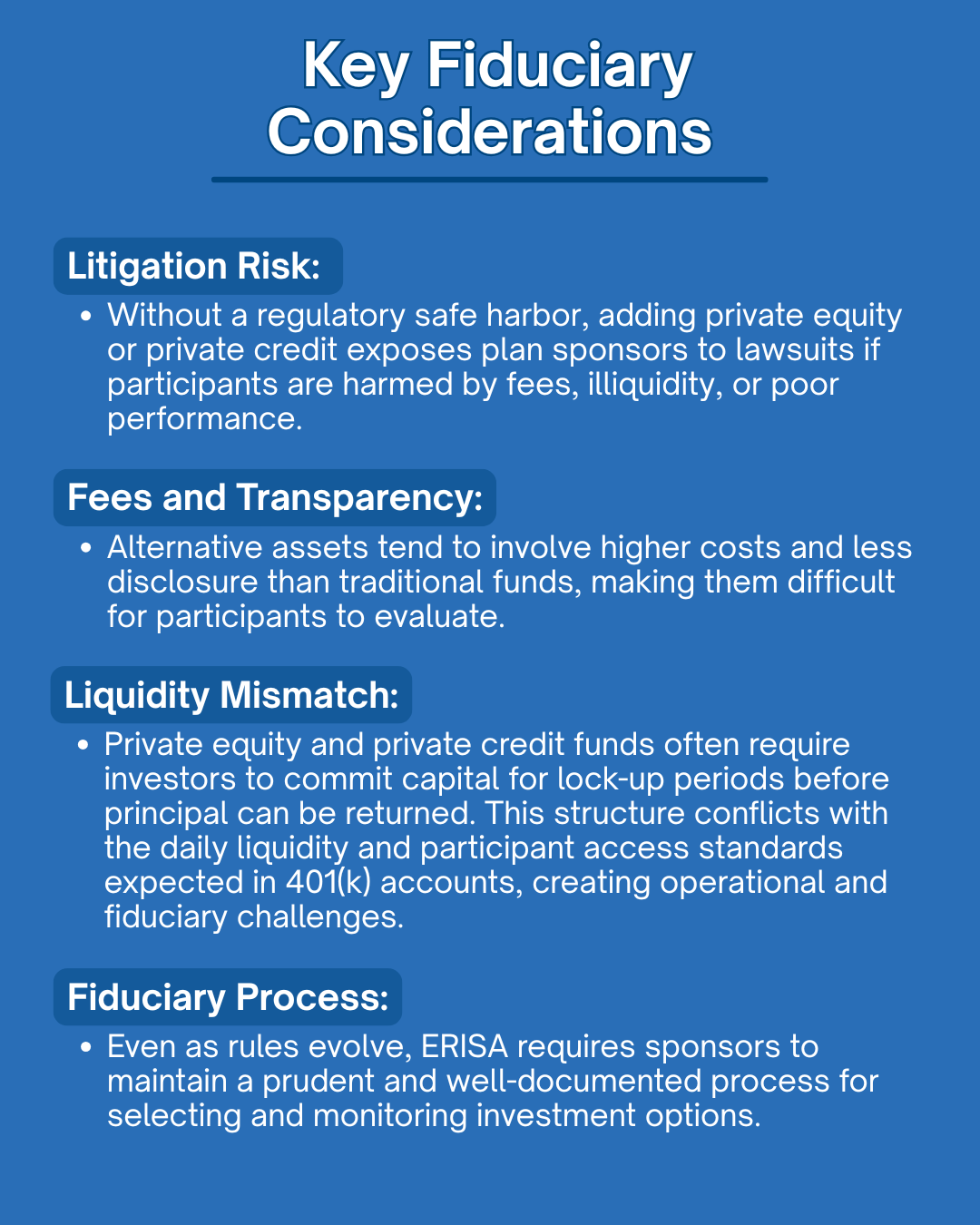
- Litigation Risk: Without a regulatory safe harbor, adding private equity or private credit exposes plan sponsors to lawsuits if participants are harmed by fees, illiquidity, or poor performance.
- Fees and Transparency: Alternative assets tend to involve higher costs and less disclosure than traditional funds, making them difficult for participants to evaluate.
- Liquidity Mismatch: Private equity and private credit funds often require investors to commit capital for lock-up periods before principal can be returned. This structure conflicts with the daily liquidity and participant access standards expected in 401(k) accounts, creating operational and fiduciary challenges.
- Fiduciary Process: Even as rules evolve, ERISA requires sponsors to maintain a prudent and well-documented process for selecting and monitoring investment options.
Likely Pathways: Target-Date Funds and Managed Accounts
Private equity and private credit are most likely to enter defined contribution plans through target-date funds or managed accounts. This structure allows professional managers to handle allocation and liquidity but still requires fiduciaries to prudently evaluate the overall suitability of these products for plan participants.
What About Crypto?
While private markets are gaining momentum, cryptocurrency remains highly scrutinized. The DOL’s 2022 compliance release urged fiduciaries to exercise “extreme care” before adding digital assets, citing volatility, valuation uncertainty, and custodial risks. Unlike private equity or credit, there has been no executive order or favorable policy shift supporting crypto in retirement plans. Litigation has already been filed against sponsors offering it, underscoring that crypto remains a fiduciary liability rather than a prudent investment option.
Considerations for Plan Sponsors
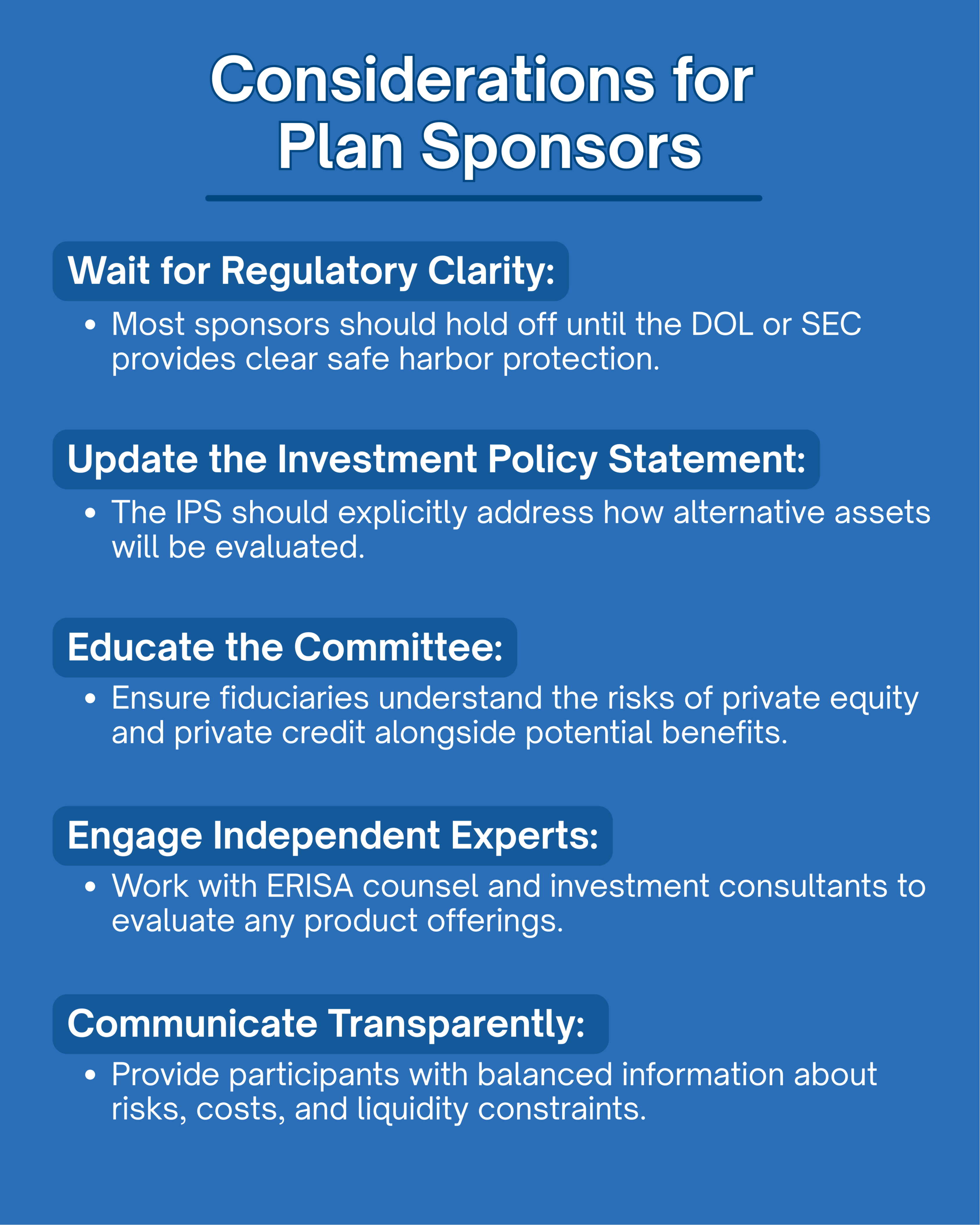
- Wait for Regulatory Clarity: Most sponsors should hold off until the DOL or SEC provides clear safe harbor protection.
- Update the Investment Policy Statement: The IPS should explicitly address how alternative assets will be evaluated.
- Educate the Committee: Ensure fiduciaries understand the risks of private equity and private credit alongside potential benefits.
- Engage Independent Experts: Work with ERISA counsel and investment consultants to evaluate any product offerings.
- Communicate Transparently: Provide participants with balanced information about risks, costs, and liquidity constraints.
Bottom Line
References
- Jeffrey Hooke, Investment Performance Review of Major PE-LBO Families, Johns Hopkins Carey Business School / SSRN, May 2024. Link
- Defined Contribution Alternatives Association, Private Credit in Defined Contribution Plans: Enhancing Retirement Outcomes Through Diversification and Yield, July 2025. Link
- Committee on Capital Markets Regulation, Expanding Opportunities for U.S. Investors and Retirees: Private Markets, August 2025. Link
- Executive Order, Democratizing Access to Alternative Assets for 401(k) Investors, August 7, 2025.
- U.S. Department of Labor, Information Letter on Private Equity in Defined Contribution Plans, June 3, 2020.