

By Dennis Karpenko, CFA
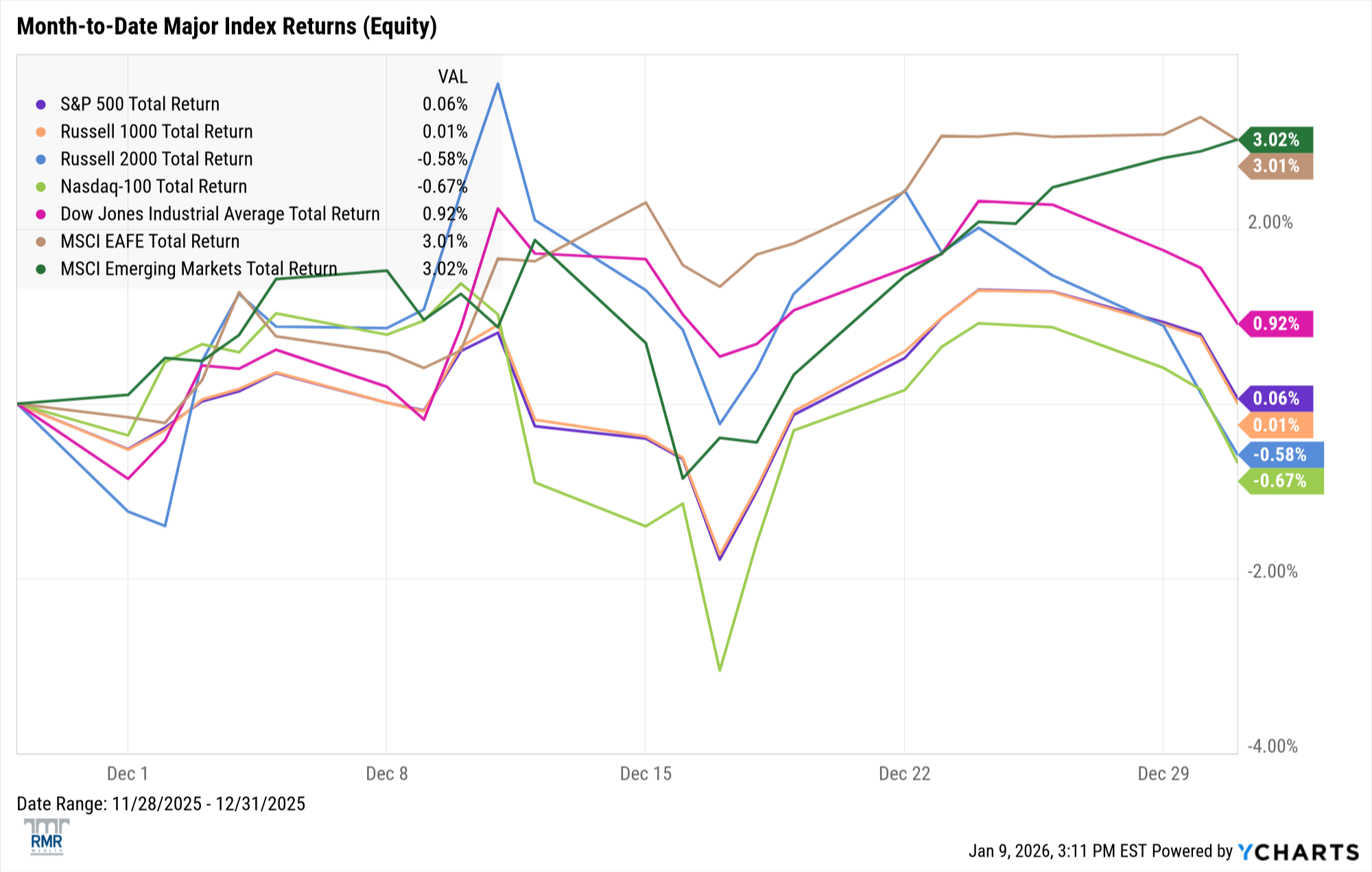
The markets in 2025 went through some periods of turbulence, but once again presented investors with a strong year of returns. The first half of the year placed a big focus on trade concerns and tariffs, while the latter half shifted most conversations over to monetary and fiscal policy. Despite these concerns and some degree of economic uncertainty moving into 2026, 2025 ended up being the first year since the pandemic where all major asset classes produced positive returns for investors.
Equities
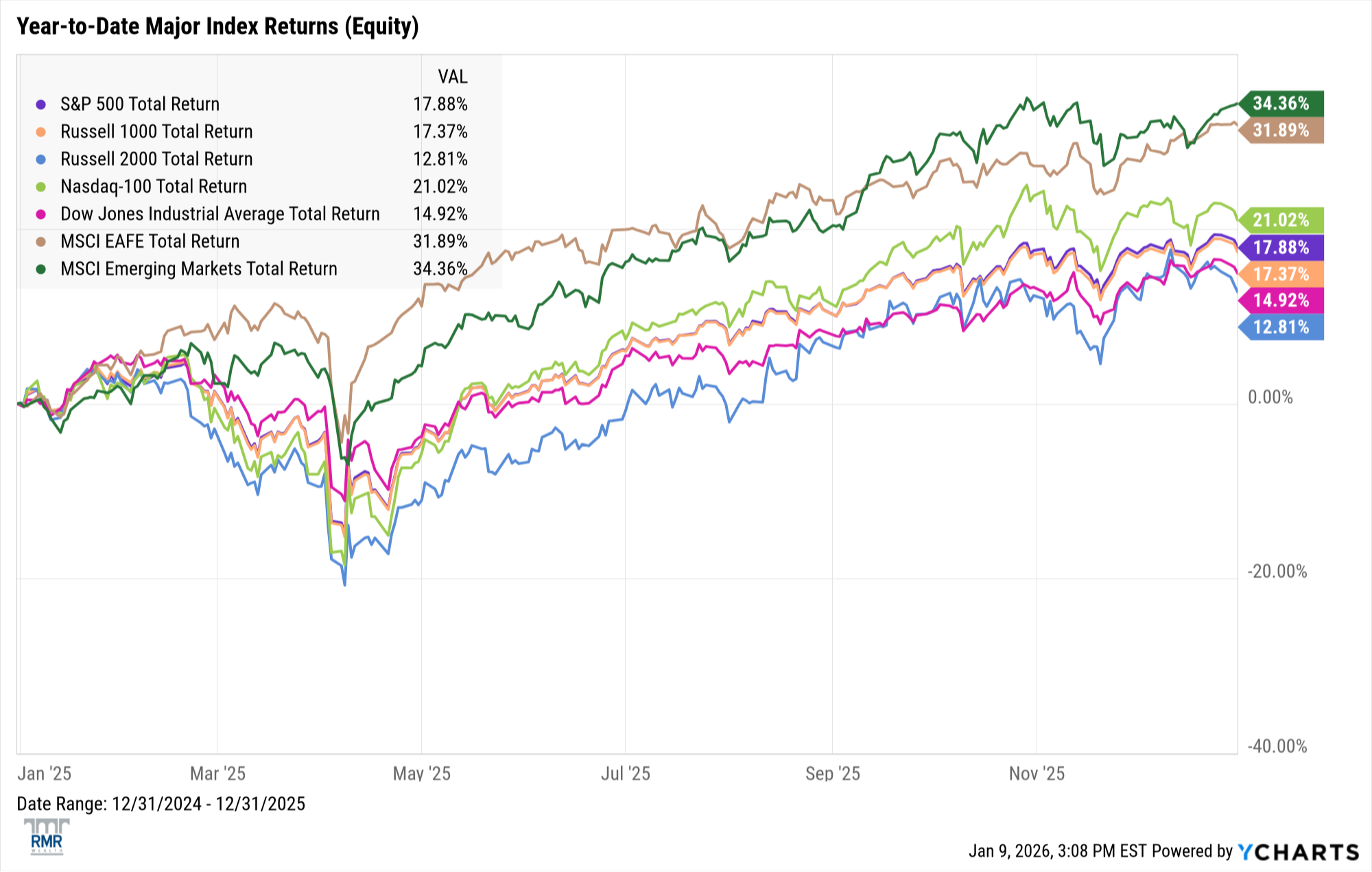
Equities had a very positive year, with international equities staying ahead of domestic equities to close 2025. Both developed and emerging market equities delivered north-of-30% returns on the year and reaffirmed how important it is to incorporate these names into a diversified portfolio. International markets were largely boosted by increased government spending as well as a weakening U.S. dollar.
Domestic equities delivered strong results as well. The S&P 500 finished up over 17%, the NASDAQ over 21%, and the DJIA over 14%. Even the small cap index in the Russell 2000, which had a drawdown of over 20% at one point during the year, concluded 2025 with a total return of over 12%.
In the U.S., artificial intelligence remained the most prominent theme in the markets, significantly boosting certain sectors as investors looked to capitalize on the “big winners” in the AI race. Technology and communication services benefited most from this development, up over 24% and 23%, respectively. Real estate and consumer staples were at the bottom of the pack (up just over 2.5% and 1.5% each).
Fixed Income
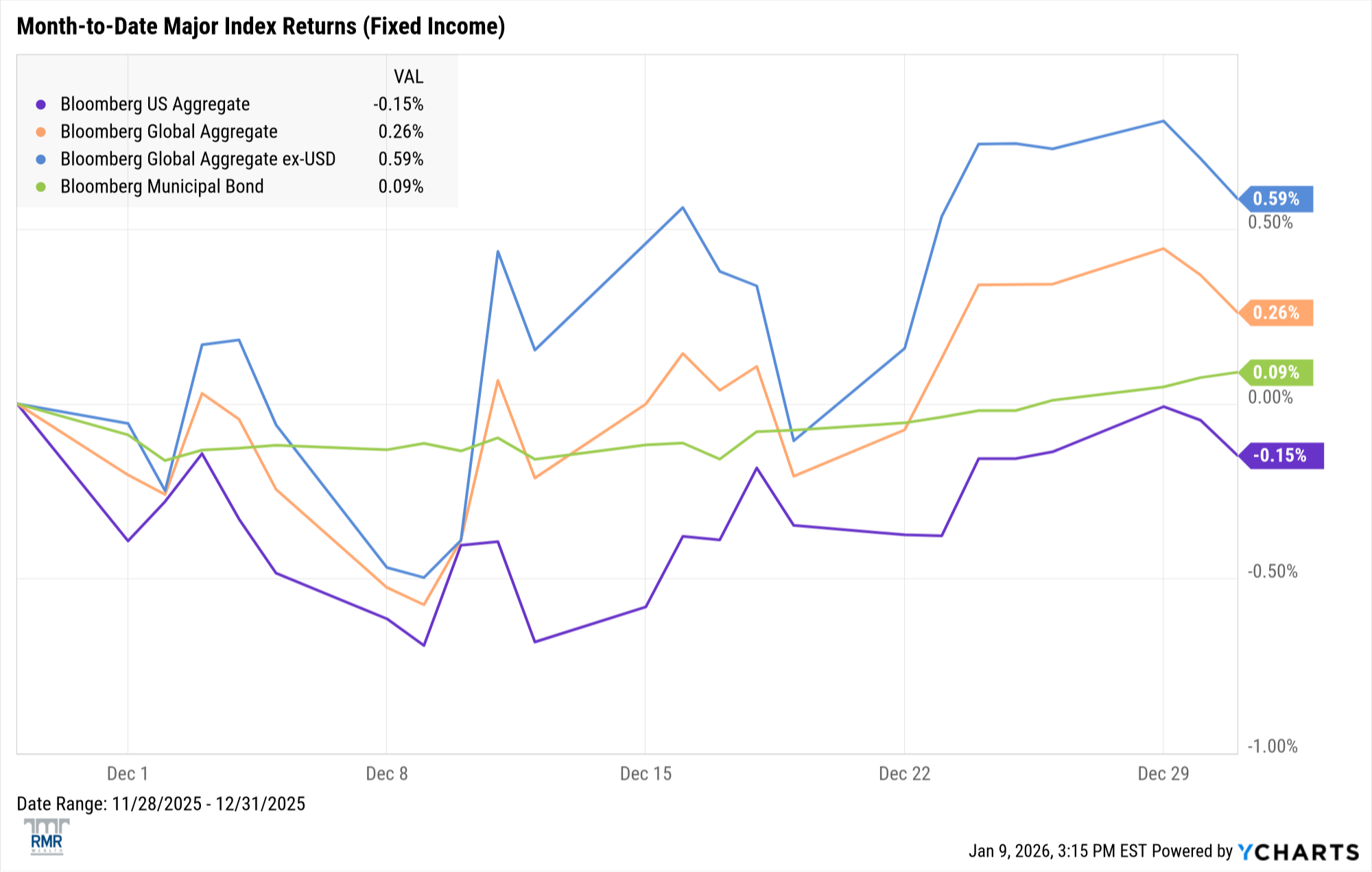
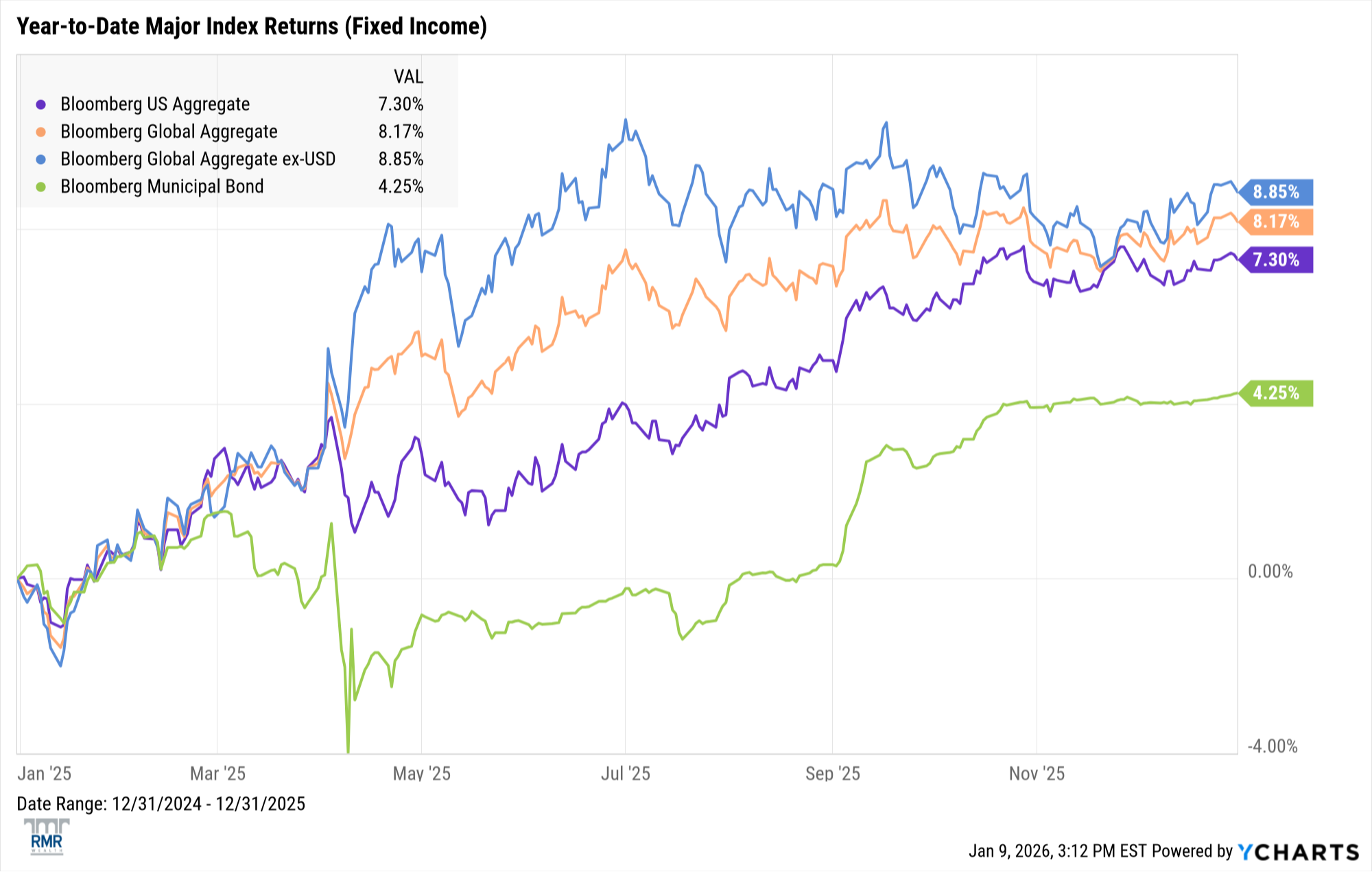
The rally in risky assets in 2025 extended to bonds as spreads compressed across the board. As a result, credit-sensitive sectors outperformed interest-rate-sensitive sectors. With the Fed cutting rates twice in the fourth quarter, treasury yields have dipped across most of the curve except for longer-dated bonds; curves have continued to steepen in major markets as investors now have more of an incentive to invest in these longer-term bonds.
Municipal bonds ended 2025 in a strong position, following a weak first half of the year. The Bloomberg Municipal Bond Index finished the year up over 4%, with almost all of that return being generated since September.
Economic Recap
In a year where concerns with tariffs and inflation expectations created a meaningful “pause” in Fed easing, the market still saw rates decrease by 75 basis points in 2025. Although it is difficult to determine exactly how the Federal Reserve will approach rates throughout 2026, estimates indicate that anywhere between 1 and 3 further rate cuts are on the table, for now.
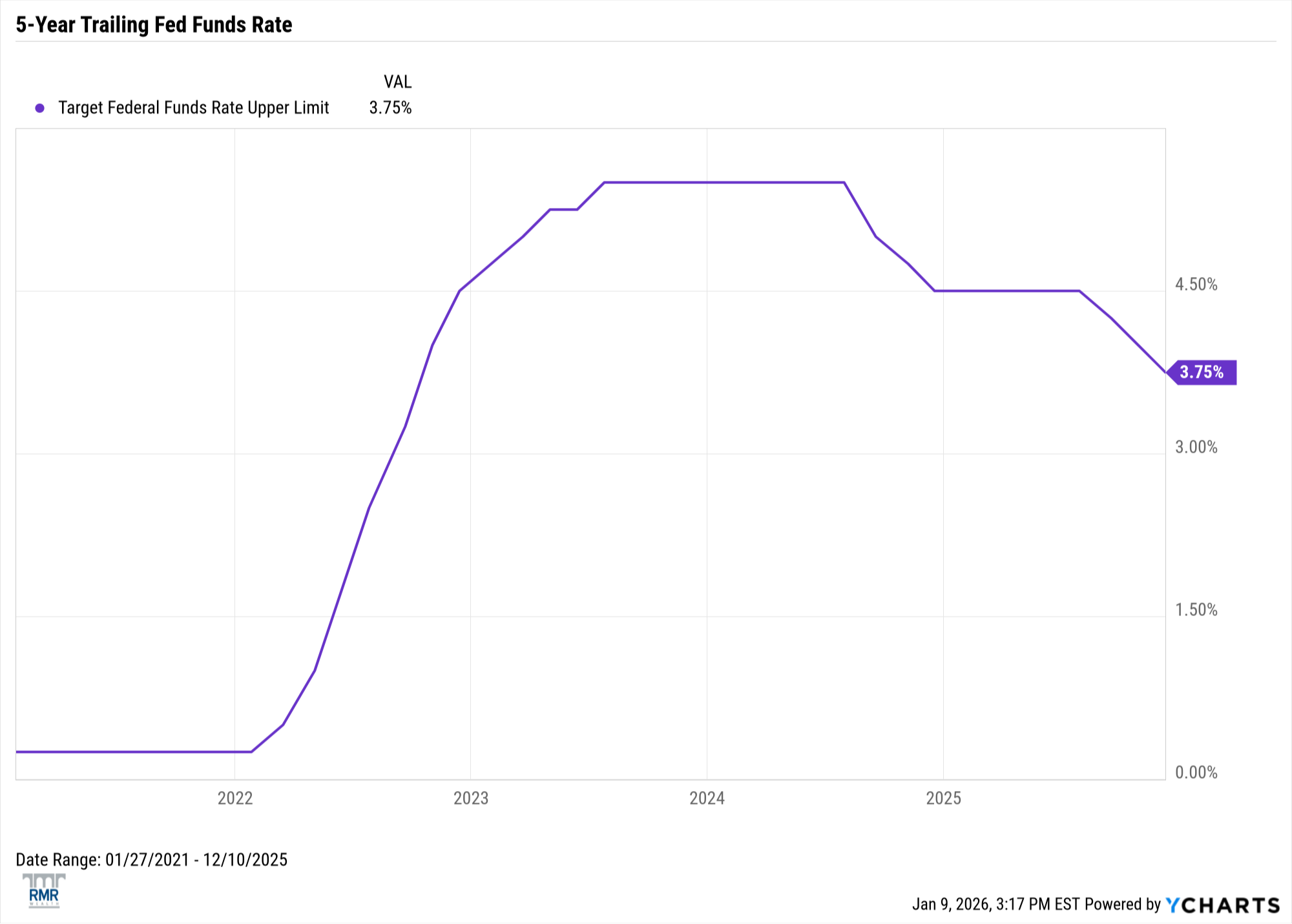
Other notable economic figures:
U.S. Labor Force Participation Rate
| December, 2025 | November, 2025 | October, 2025 | September, 2025 | August, 2025 |
| 62.40% | 62.50% | - | 62.40% | 62.30% |
U.S. Unemployment Rate
| December, 2025 | November, 2025 | October, 2025 | September, 2025 | August, 2025 |
| 4.40% | 4.50% | - | 4.40% | 4.30% |
U.S. Inflation Rate
| December, 2025 | November, 2025 | October, 2025 | September, 2025 | August, 2025 |
| Pending | 2.68% | - | 3.01% | 2.92% |
Disclosures
Investing involves risks, and investment decisions should be based on your own goals, time horizon, and tolerance for risk. The return and principal value of investments will fluctuate as market conditions change. When sold, investments may be worth more or less than their original cost.
The forecasts or forward-looking statements are based on assumptions, may not materialize, and are subject to revision without notice.
The market indexes discussed are unmanaged and generally considered representative of their respective markets. Index performance is not indicative of the past performance of a particular investment. Indexes do not incur management fees, costs, and expenses. Individuals cannot directly invest in unmanaged indexes. Past performance does not guarantee future results.
U.S. Treasury Notes are guaranteed by the federal government as to the timely payment of principal and interest. However, if you sell a Treasury Note prior to maturity, it may be worth more or less than the original price paid. Fixed income investments are subject to various risks, including changes in interest rates, credit quality, inflation risk, market valuations, prepayments, corporate events, tax ramifications and other factors.
International investments carry additional risks, which include differences in financial reporting standards, currency exchange rates, political risks unique to a specific country, foreign taxes and regulations, and the potential for illiquid markets. These factors may result in greater share price volatility.
Please consult your financial professional for additional information.
This content is developed from sources believed to be providing accurate information. The information in this material is not intended as tax or legal advice. Please consult legal or tax professionals for specific information regarding your individual situation.